Monday, January 2, 2012

Our Lady of Fatima, Kazan, Soufanieh and Walsingham: Busy Lady!


BY ROB MORELAND

Over the New Year’s weekend, I read about the apparitions of Our Lady of Soufanieh, to a woman in Damascus, Syria, beginning in 1982. Our Lady has appeared to a Melkite Catholic woman named Myrna Nazzour, wife of a Syrian Orthodox man named Nicholas Nazzour. They live in a neighborhood of Damascus, not far from where St. Paul was converted, called Soufanieh, hence the title Our Lady of Soufanieh.

I first learned of Marian apparitions when I read a book about Our Lady of Fatima, 
some 30 years ago. In 1917, she appeared  to the three children in Fatima, Portugal, and the story of those apparitions left a lasting impression on me. In fact, just prior to Christmas, I reread Fr. Apostoli’s excellent book, Fatima for Today.

Perusing the Internet over the holidays, I stumbled across YouTube videos of Myrna Nazzour receiving the stigmata while in ecstasy. The videos were part of a video documentary put together by Rick Salbato of Unity Publishing. The documentary has the Imprimater of the Roman Catholic Archbishop of Damascus.

Testimonials to the authenticity of the phenomenon at Soufanieh have come from bishops and patriarchs of Catholic and Orthodox churches.  

Looking for additional information on Myrna, I found a book on Our Lady of Soufanieh at the Fatima Family Apostolate International website, authored by the late Fr. Robert J. Fox, and published in 2002. This is the book I read over the New Year’s weekend. I’m quite impressed with how active Our Lady is in our world.

The Soufanieh miracles began in 1982, when pure olive oil began to exude from a small icon of Our Lady of Kazan in the home of Nicholas and Myrna Nazzour. Olive oil also began to exude from the palms of Myrna’s hands. Our Lady indicated to Myrna that her home should be open to the faithful and it has ever since. She and Nicholas’ home is always open to the faithful and all are welcome into their home to venerate the icon.

So, what is the message Our Lady and Jesus conveyed to Myrna? She and Jesus communicate with Myrna while she experiences ecstasy during their apparitions to her. They ask for Unity. They want unity of Christians, beginning with the unification of the Catholic and Orthodox churches.

Who wouldn't want that? Unfortunately, there are many who want unity, but only on their own terms.

And speaking of Unity, this brings me to the news of January 1st, on which date Pope Benedict XVI, established a home for U.S. Anglicans and Episcopalians, that wish unity with the Roman Catholic Church, but wish to retain distinctive elements of their theological, spiritual, and liturgical patrimony. The new home is called the Personal Ordinariate of the Chair of St. Peter.

By the way, the ordinariate is under the protection of Our Lady of Walsingham.

Our Lady sure stays busy!

Rob Moreland is the Communications Director for the Men of St. Joseph.

Wednesday, December 28, 2011

Bill Harkins: Obadiah, a Model of Average Guy Heroics

Have you ever heard of Obadiah?  If so, you might be thinking of the prophet who is credited with writing one of the smallest books in the Bible.  That’s not who I am talking about.  I am talking about another Old Testament figure, who only shows up for 20 short verses in 1 Kings 18:1-20.

This Obadiah was a faithful servant of God, who worked as Chief of Staff for an evil King named Ahab.  In this story, Elijah, the great prophet is returning from hiding in order to be God’s instrument to end the terrible drought and famine brought on by Ahab and his wicked wife, Jezebel.  Among multiple bad behaviors, the royal couple worshiped Ba’al and other false Gods.

Obadiah’s role is that he ensures Elijah and Ahab meet face to face, starting an episode that leads to a great showdown between the Prophet and hundreds of Ba’al priests, a large dose of fire from above and all the prophets being killed.  When the smoke clears and the blood is cleaned up, Elijah invites the King to a covenant meal with God.

A thing for us to think about is that God used a regular guy, Obadiah (maybe his friends called him Obi for short?) to link the two key men in this scenario together.  Our Lord could have accomplished this in all kinds of ways, but he chose Obadiah, who is not heard from again after this event is over.  By the way, the big O is also described as saving a hundred of God’s prophets, hiding them in a cave and ensuring they were fed and had water – this during a drought and famine.  Not an easy task.

Obi shows his humanity by arguing with Elijah about being sent to announce the prophet to Ahab.  Read the story.  Our man, really, really, does not want to do this.  He does though, and the rest is truly history.

What I am getting to is this: we are like the big O, just regular guys with heroic tasks in front of us from time to time.  When you are placed in a situation like this, think of Obi and how his faith pulled him through some tough situations.  God placed him there for a purpose, he places you where you are for a reason too.  I challenge you to read through the Bible, looking for some of the regular folks.  What can you learn from them?  Why are they in our Scriptures?  Through them, God to speaks to us.

I am now a fan of Obadiah, I pray that I have his strength, even when I am fearful.  God Bless!!


About Bill Harkins
Bill Harkins is a husband and father, retired Marine, theology student, and candidate for the permanent deaconate for the Archdiocese of Mobile. He is an active member of St. Ignatius Parish, Mobile, Alabama.

Martignoni: Where is Purgatory found in the Bible?


BY JOHN MARTIGNONI

Question:
I have an Evangelical friend at work who claims that the Catholic belief in Purgatory is not scriptural.  What should I say to him?

Answer:
2 Sam 12:13-18, “David said to Nathan, ‘I have sinned against the Lord.’  And Nathan said to David, ‘The Lord also has put away your sin; you shall not die.  Nevertheless, because by this deed you have utterly scorned the Lord, the child that is born to you shall die.’  And the Lord struck the child that Uriah’s wife bore to David, and it became sick…On the seventh day the child died.”  Catholic Scriptural Principle #1 – there is punishment for sin even after one has received forgiveness.

Rev 21:27, “But nothing unclean shall enter it…”  The New Jerusalem – Heaven.  Catholic Scriptural Principle #2 – nothing unclean, nothing with the stain of sin, will enter Heaven.  

Mt 5:48, “You, therefore, must be perfect as your heavenly Father is perfect.”  That’s because of Principle #2 – nothing unclean will get into Heaven.

Heb 12:22-23, “But you have come to Mount Zion and to the city of the living god, the heavenly Jerusalem...and to a judge who is God of all, and to the spirits of just men made perfect…”   The spirits of just men, made perfect.  Catholic Scriptural Principle #3 – there is a way, a process, through which the spirits of the “just” are “made perfect.”

1 Cor 3:13-15, “…each man’s work will become manifest; for the Day [judgment day] will disclose it, because it will be revealed with fire, and the fire will test what sort of work each one has done.  If the work which any man has built on the foundation survives, he will receive a reward.  If any man’s work is burned up, he will suffer loss, though he himself will be saved, but only as through fire.”  Where is this place that a man, after he dies, suffers loss, as through fire, but is still saved.  Hell?  No, once you’re in Hell, you don’t get out.  Heaven?  No, you don’t suffer loss in Heaven.

Mt 12:32, “And whoever says a word against the Son of man will be forgiven; but whoever speaks against the Holy Spirit will not be forgiven, either in this age or in the age to come.”  Implies forgiveness in the age to come.  Where can you go to be forgiven in the age to come?  Heaven?  You don’t need forgiveness.  Hell?  There is no forgiveness.  Catholic Scriptural Principle #4 – there is a place, or state of being, other than Heaven or Hell.  

Now, let’s summarize these four scriptural principles: There is punishment for sin even after one has received forgiveness.  We have to be perfect as the Father is perfect, because nothing unclean will enter Heaven.  There is some way, or process, by which the spirits of the just are made perfect.  There is a place besides Heaven or Hell where you can suffer loss, yet be saved, but only as through fire; and where you can be forgiven of sins from a previous age.  It all adds up to one inevitable conclusion - the Catholic teaching on Purgatory is indeed scriptural.

About John Martignoni
John Martignoni is the Director of the Office of Evangelization for the Diocese of Birmingham in Alabama and also the President of the Bible Christian Society. John's column, Apologetics 101, appears regularly in the diocesan newspaper, the One Voice.  If you have a question about the Catholic Faith, please send an email to: jmartignoni@bhmdiocese.org.  And check out John's free audio and written apologetics materials at: www.biblechristiansociety.com.

Fr. Barron on "dumbed down" Catholicism

Thursday, December 22, 2011

Is God With Us? A Christmas Story

BY DAVID O’BRIEN

Christmas serves as a concrete reminder that God is with us and God is active, not just on December 25 but every moment of every day. Often God’s work goes unnoticed like when he slipped in behind enemy lines on that first Christmas morning.

The task is to stay attentive to the signs, to sit with the unknowns and allow God to lead us to the Christ child.

We won’t always know where God is working in our lives or in human history. But the Christmas account is proof positive that God is among us. The question is: are we open and available?

Some years ago, a couple, Sara and Joe, took a pilgrimage. Not an ordinary pilgrimage, mind you. This would be a journey completely dependent upon God.

The plan was to start in China where Sara had worked as a Catholic missionary in the underground Church. From there they would go where the Spirit led them. The only other contact they had was a priest in India.

With an openness to God that would seem reckless to most, they began. In each village, they introduced themselves as missionaries and servants of Christ. If they were welcomed, they stayed. If not, they moved on. (Lk 9:4-5) They ate what they were offered and slept where they could lay their heads.

Often, the people of the village would invite them into their homes or their churches, asking them to share a message with them. They spoke of their journey, their adventures and how God miraculously provided for them. Mostly though, they witnessed to the love of God, available for all people through Christ.

Sometimes, after hearing their witness, someone would say "I must introduce you to my brother". Joe and Sara took that as a sign that the Spirit was directing their next step. So they went. Little did they know that "the brother" lived 14 hours away in Tibet, Nepal or Bangladesh.

Country to country, village to village, church to church they followed God’s lead for over six months. Without a car or much money, they relied on God to direct their steps and provide for their needs.

When Christmas arrived, they were in a remote Muslim area of Turkey without access to a Christian church of any sort. Despite all the ways God had taken care of them and the incredible opportunities they were given to share Christ’s love, they felt alone and cut off that Christmas Eve.

They knew God was everywhere. After all, the central message of Christmas is that God is with us (Emmanuel). Still, they longed for a Christian community with which to celebrate the savior’s birth. They desired to receive the Eucharist and experience that holy communion between God and humanity, a communion incarnated on that first Christmas morning.

Disheartened, they turned to prayer, reading the stories of Joseph and Mary, the shepherds and the angels, the donkeys and the sheep. They imagined them all gathered in that dusty, remote outpost of the Roman Empire. They pictured the glow of awe and wonder on their faces as they welcomed the Christ child.

Noticing the similarities between their rugged reality and the cave that housed the baby Jesus, Sara suggested to Joe: "Let’s go off by ourselves for an hour to listen to the Lord speak to us of Christmas. When we return, we will know how to celebrate and worship the newborn king."

An hour passed and they both returned with the same idea. "Let’s create a manger scene right here".

With single-hearted devotion, they whittled branches, gathered rocks, collected moss, grass and twigs until, as the sun set, they knelt before a hand carved Christmas crèche, complete with animals, angels and the Holy Family.

There, they spontaneously praised the great gift of God, who held nothing back to show His love. There, in the hills of Turkey with only stars for light and roaming animals to keep them company, they heard God speak: "The people in darkness have seen a great light...For unto us a child is born, a son is given...They name him Wonder-Counselor, God-Hero, Father-Forever, Prince of Peace." (Is 9)

Years have passed and Sara and Joe now have four children of their own. Each Christmas they pull out that sacred homemade crèche set, still lovingly preserved. Now, however, there are four new pieces, equally handcarved in a spirit of reverence and praise. The children love to see themselves as little fi gurines kneeling in front of the baby Jesus. Joe says, "it makes them feel like they were there. We like it because it reminds us that God is with our children."

Christmas comes once a year, but Christ is born again and again to those who are not too busy to notice.


About David O’Brien

David O’Brien is the Associate Director of Religious Education for Lay Ministry for the Archdiocese of Mobile. His column, Everyday Faith, appears regularly in the archdiocesan newspaper, the Catholic Week. Email David at dobrien@mobilearchdiocese.org.

Wednesday, December 21, 2011

Heavyweight Fight: Santa Claus vs. Saint Nicholas Should there be a battle to see who is the best symbol of Christmas spirit?


BY CHRIS TEAGUE

It would be great to see the spiritual foundations of Santa Claus….Sankt Niklaus…Saint Nicholas make a comeback in the United States.   Obviously Santa Claus has been high jacked by the commercial interests in this country and therefore he is almost seen as evil in some fundamentalist circles.   But, I think Catholics families should want to help “devolve” Santa back to who he really is.  We need to bring out the REALITY of Santa Claus, and maybe Santa could once again become a symbol of Christ not just a symbol of Christmas commercialism.    At his core Santa Claus is still St. Nicholas however we simply fail to recognize the patron saint of children beneath all the layers of commercialism our culture has placed on him.

One article on www.stnicholascenter.org put the situation nicely,
“It's been a long journey from the Fourth Century Bishop of Myra, St. Nicholas, who showed his devotion to God in extraordinary kindness and generosity to those in need, to America's jolly Santa Claus, whose largesse often supplies luxuries to the affluent. However, if you peel back the accretions, he (Santa Claus) is still Nicholas, Bishop of Myra, whose caring surprises continue to model true giving and faithfulness.”

From a practical standpoint, I don’t know if it’s possible to truly purge Santa Claus from American Culture (or if we want to) however, I do think it is possible to restore his saintly heart….give Santa Claus a much needed spiritual makeover.   Use that symbol to promote Christ and His Church, not just to promote Coke and Wal-Mart. 


Below is another gem from www.stnicholascenter.org and was written by J. Rosenthal & C. Myer.
Santa Claus belongs to childhood;
St. Nicholas models for all of life.
Santa Claus, as we know him, developed to boost Christmas sales—the commercial Christmas message;
St. Nicholas told the story of Christ and peace, goodwill toward all—the hope-filled Christmas message.
Santa Claus encourages consumption;St. Nicholas encourages compassion.
Santa Claus appears each year to be seen and heard for a short time;
St. Nicholas is part of the communion of saints, surrounding us always with prayer and example.
Santa Claus flies through the air—from the North Pole;
St. Nicholas walked the earth—caring for those in need.
Santa Claus, for some, replaces the Babe of Bethlehem;
St. Nicholas, for all, points to the Babe of Bethlehem.
Santa Claus isn't bad;
St. Nicholas is just better.

Chris Teague
Chris is the Evangelization Director for the Men of St. Joseph.


An Advent Spiritual Exercise: Lord, This Is The People Who Long To See Your Face! The Face Of Christ by Joe Castillo, SandStory® Artist


BY FR. JAMES J.M. REYNOLDS, S.T.L.

With the death of King David, whom many Israelites presumed to be the promised Messiah, God's People, Israel, waited 1,037 years for the advent, the coming of the Christ. 
   
During all that time, a small remnant of God's holy and devout People continued praying, fasting, doing penance, and expecting God's promised Messiah to come during their lifetime.  The Psalms express their yearning and prayers for a Savior: 

"Who shall ascend the mountain of the LORD? And who shall stand in his holy place?  He who has clean hands and a pure heart, who does not lift up his soul to what is false, and does not swear deceitfully.  He will receive blessing from the LORD, and vindication from the God of his salvation.  Such is the generation of those who seek him, who seek the face of the God of Jacob." (Psalm 24:3-6)
Psalm 105:4-6 also captures this yearning as it advises God's people to seek Him:
"Seek out the LORD and his might; constantly seek His Face. Recall the wondrous deeds he has done, his wonders and words of judgment, You descendants of Abraham his servant, offspring of Jacob the chosen one!"

Here's the story of a man who longs to help others to seek and recognize the Face of God, in Jesus Christ.  The man's name is Joe Castillo.

 Joe Castillo grew up in Mexico.  His love for art and storytelling was strongly influenced by his mother, who taught painting, and his father, who owned a graphic design company.   By age five he was enrolled in his mom’s art class for the neighborhood children. By eight his father was teaching him to hand letter brush script. 

Then, at fourteen, he attended an artist’s chalk talk at a Christian youth camp in Mexico. He was so moved by the drawing and the powerful message that he accepted Christ that night. For the next forty years his love of art and his passion for God would inspire and guide his life. 

After his father’s death in 1963, the Castillo Family moved back to the US. 
Joe finished high school, studied at the Ringling School of Art in Sarasota and enrolled at Florida Bible College, where he received a Bachelor’s degree in Bible. 

Joe developed a love for writing, teaching and using his artwork for telling stories.  He became a regular speaker at youth camps and churches. 

Joe created his own advertising firm, and worked in that field for twenty years.  But, during the entire time, Joe entertained and captivated thousands of audiences -- in both English and Spanish -- by telling and drawing stories that inspire, motivate and touch the heart. 

After eighteen years in advertising and the loss of his wife of twenty-six years to breast cancer, he sold his ad agency, went back to school and graduated from Asbury Seminary. 

His profound love of teaching the scriptures inspired him to illustrate what he was learning in a new way. These illustrations attempted to present the Bible in an intricate story-form that grew out of the Biblical passages.  


His latest adventure in storytelling is something Joe calls SandStory®.  

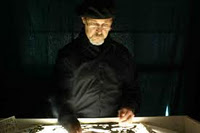
Drawing in sand on a light table, he is able to create powerful, fluid illustrations for large audiences with an overhead video camera projected on a large screen. 

His presentations have been seen by thousands of people leaving them with a sense of awe. 

He has created performances for CBS, NBC, BBC, TED, over thirty Fortune Five hundred companies, Kings, presidents and dignitaries in more than 18 countries around the globe. 


Joe Castillo without question is the top SandStory artist in the world today! 

Here is an excerpt from a blog for and about illustrators, called Mark Armstrong, Illustration.   In this excerpt, entitled, Joe Castillo’s Face Of Christ, Mark Armstrong tells us:

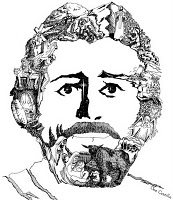
A friend of mine sent me a copy of  The Face of Christ by Joe Castillo. I was enormously impressed. As you can see, the artist has incorporated major events from Christ’s life and ministry into the drawing, mostly in the beard and hair.
The rolled away stone of the empty tomb corresponds nicely to where the ear would be, and the stars in the eyes provide a sense of scale for the Star of Bethlehem, which is tucked into the shadow of the nose. I think my favorite touch is using the Sea of Galilee and its mountain backdrop for the right eyebrow.   
    
Here is Joe’s portrait of Our Lord, called, The Face Of Christ.  Look closely.  
    
There are several smaller drawings which comprise the portrait of the Lord’s Face. 
    
These smaller drawings tell the whole story of Our Lord Jesus’ life.
    
In case you have trouble recognizing them, here’s the portrait done up with the references to the events of Christ’s life, death, and resurrection (taken from Mark Armstrong, Illustration, who based it on the references given at this tribute site: http://jerryjeffries.net/FaceOfChrist.html):


Here's an easy and profitable Advent spiritual exercise, using Joe's The Face Of Christ:  

Print out the Face above.  Sit and look into this Face for a little while.  It can help you focus on "The Reason" for the Christmas Season. And it can help you to make the connections between all of the major events in Our Lord Jesus Christ's thirty-three years on earth with us.  


In The Book Of Exodus (33:18-33), God reveals to us through Moses, that no mere mortal may see God's Face directly. We would not be able to survive the experience of seeing absolute goodness, absolute truth, and absolute holiness.  Not understanding this yet, Moses presses God for a glimpse of Him:

Then Moses said, “Please let me see your glory!”  The LORD answered: I will make all my goodness pass before you, and I will proclaim my name, “LORD,” before you; I who show favor to whom I will, I who grant mercy to whom I will.  But you cannot see my face, for no one can see me and live."  "Here," continued the LORD, "is a place near me where you shall station yourself on the rock.  When my glory passes I will set you in the cleft of the rock and will cover you with my hand until I have passed by.  Then I will remove my hand, so that you may see my back; but my face may not be seen."

With the coming of God's Son, God-in-Human-Flesh, Jesus, mortal men have finally seen the Face of God!  And lived!  And even more than simply surviving it, we see Christ's Face and He leads us into eternal life with Him!

As you study Joe Castillo's  The Face Of Christ above, remember:

Every event depicted in this Face was accomplished for you personally -- and for all of us!  

Try reading the Scripture Passages indicated for each event. And allow yourself to pray to Our Lord, and ask Him to return, to come again, and to eternally establish His Heavenly Kingdom here on earth.

God bless you!

Fr. James J.M. Reynolds
Reverend Father James J.M. Reynolds, STL, serves as the chaplain of the Men of St. Joseph chapter, Diocese of Rockville Centre. He writes his own blog at www.catholicjediacademy.com.